Accelerated Resolution Therapy Success Stories: Real Trauma Therapy Journeys
Trauma does not unfold in neat chapters, and healing rarely follows a straight line. Yet in the room with a trained clinician, I have watched people reorganize their memories and, with them, their lives. Accelerated resolution therapy has a way of surprising both client and therapist, not because it is magical, but because it uses the brain’s natural capacity to recode how distressing events are stored. The result often looks like relief arriving faster than expected, paired with clearer thinking and steadier sleep. That is not every case, and it is not the only path. Still, when ART is https://mariobqvl121.wpsuo.com/ifs-therapy-for-financial-anxiety-calming-money-fears a match for a person and a problem, the shift can be striking.
I first learned ART from a colleague who had been using it with combat veterans who felt stuck even after months of trauma therapy. The technique borrows from what we know about memory reconsolidation, the same arc that informs EMDR, but it leans heavily on image rescripting and body cues. Clients repeatedly tell me that after a small handful of sessions they can picture the worst thing that happened, and their chest stays open instead of collapsing. Their minds still hold the facts, but the charge is gone.
What ART feels like in the room
A typical ART session runs 60 to 75 minutes. The client sits in a chair and follows the therapist’s hand with their eyes as it moves horizontally. We check in about body sensations as much as thoughts. Rather than retelling every detail, many clients say little out loud. The goal is to activate the memory network just enough to work with it, then introduce voluntary image replacement. In plain language, we invite the brain to file the same event with different pictures, different meanings, and a calmer body.
People who have tried CBT therapy or IFS therapy often notice the difference right away. ART involves almost no homework and fewer words. With CBT, we usually challenge beliefs and build skills session by session. With IFS, we get to know protective parts and wounded parts with patience and respect. ART moves more like a focused sprint. It asks, for one discrete memory at a time, can we take the sting out of this, right now, so you can get your life back.
Four real journeys, shared with permission and details altered for privacy
These are composites based on patterns I see often. Names, ages, and identifiers have been changed. The core experiences, including the stuck points and the turning points, match real therapy rooms.
Maria, 36, car crash survivor
Maria avoided left turns for two years after a truck clipped her driver’s side door. Anxiety therapy helped her breathe through panic at traffic lights, but her hands still shook at intersections. We tried ART with one clear target memory, the moment she saw headlights fill her side window.
Session one, we mapped the sequence. On the third set of eye movements, she reported pressure in her throat. We slowed down and let her track the sensation until it settled. When the image came back, we invited a new version: her car surrounded by a ring of safety lights and a perfectly timed green arrow. That picture would not change what happened in 2022, but it changed how her brain stored the event. She came the next week saying she drove through two left turns without a racing heart. We ran a second session to clean up the sound of screeching brakes, which had started appearing in her dreams. She replaced it with the steady click of a turn signal, a surprising choice that worked for her nervous system. Three weeks later, she rated her driving fear a 1 out of 10 on most days. She kept her CBT skills for general stress. The trauma memory itself lost its edge.
Devin, 29, childhood medical trauma
Devin grew up with repeated hospitalizations for a congenital heart condition. He carried an adult belief that his body would fail him, baked in after childhood nights under fluorescent lights. Traditional trauma therapy had taught him about hypervigilance. IFS therapy helped him speak gently to the part of him that never left the pediatric ward. He wanted the fear to stop ambushing him when he heard beeping sounds.
We targeted one memory, lying alone while a monitor alarm misfired at 3 a.m. On the first pass, he replaced the image of the beeping with a rhythmic ocean wave. His shoulders dropped. Midway through the session, the fear shifted to anger at a nurse who never came. We resourced him with an image of a dependable adult advocate standing by the bed, hand on the call button. He smiled for the first time, then tears. By session three, he brought a different incident, waking post-surgery without a parent in the room. The replacement image was vivid: his current self walking in, telling the younger self, you are not alone. Six weeks later, he reported that his resting heart rate had steadied by five to seven beats per minute, and he could sit through a dentist visit without white knuckles. He still used CBT tools for everyday stress at work, but the medical cues had lost their grip.
Sahana, 44, workplace harassment
Sahana, a senior engineer, carried a loop of humiliation from a meeting where her manager mocked her accent. Two years had passed, but any time she prepared to present, her mouth went dry and her vision narrowed. She had tried assertiveness training and cognitive reframes about the manager’s insecurity. They helped, but the memory kept intruding.
ART gave her a way to retell that room to her body. During eye movements, she replayed the meeting and replaced the smirk on his face with a frozen frame, then a blank screen, then an image of a colleague meeting her gaze with respect. We anchored the feeling of solid feet on the floor. She later chose a stronger ending: in her mental movie, she stood up, named the behavior, and walked out. That last move did not happen in real life, but when she played the tape differently, the shame dissolved into anger, then clarity. Two sessions later, she presented to 80 people and noticed nerves without the old collapse. Her weekly anxiety therapy sessions stretched out to once a month.
Luis, 61, complicated grief
Luis lost his brother to a sudden heart attack. The death was not traumatic in the narrow sense of assault or disaster, yet the final image replayed at bedtime, and grief curdled into dread. He wanted to remember his brother without the night in the ICU blotting everything else out.
We set a clear target: the moment he heard the flatline tone. He replaced that sound with his brother’s laugh from a family barbecue, then an image of the two of them fishing at dawn. ART does not erase memory or feelings, and we spoke about that openly. The goal was not to deny the loss, but to file it alongside decades of love. Luis came back after two sessions and said he could look at photos again. Sleep returned in blocks of five to six hours. He still cried easily for months, but the fear that something else horrible would happen waned. He kept meeting with his grief group, where stories had room to breathe.
How ART works, beneath the clinical language
Accelerated resolution therapy blends bilateral stimulation, attention to body sensations, and guided imagery that revises the way distressing memories are coded. The working model draws from memory reconsolidation research. When a memory is activated under safe conditions, with enough intensity to be plastic but not so much that the person dissociates, the brain can update the associated images and meanings. ART therapists coach clients to introduce new images with intention. The person does not deny facts. They choose different visual and sensory elements that their nervous system can accept. Over repeated eye movement sets, the physical arousal tied to the old memory tends to downshift. The memory remains accessible, but it does not hijack attention in the same way.
Clinically, I watch for shifts in breath, posture, and micro-expressions. People often report waves of emotion, then neutrality. Sometimes laughter arrives at odd moments when the new image lands and the body believes it. That is usually a good sign.
What to expect in a first session
ART often begins with education and pacing. It is not unusual to handle just one target in a meeting. If someone comes in with a long, tangled trauma history, we start small, often with the most recent distressing incident or a less intense memory that still bothers them. Safety is the boundary. If a client dissociates easily, we lengthen preparation and install visual resources first.
Here is the scaffold many first sessions follow:

- Set the target and build safety: clarify one scene to work on, establish calming images or places, and agree on stop signals.
- Activate and track: evoke the memory lightly, begin eye movements, and monitor body sensations, slowing down when intensity spikes.
- Voluntary image replacement: swap in new pictures, sounds, or sequences that carry safety or mastery without denying facts.
- Install and test: replay the sequence several times to ensure the nervous system holds the change, then check related triggers in quick snapshots.
I often send clients out with simple regulation practices, not homework worksheets. A two minute breath count or a five minute walk in sunlight after session can help the brain consolidate the shift.
Where ART shines, and where it is not the first tool
Every therapy has a profile. I look for fit.
- ART can be a strong choice when a specific, distressing memory drives symptoms, such as a crash, assault, medical event, or a discrete workplace incident. People who prefer less verbal processing and want shorter courses of treatment often do well.
- CBT therapy excels when distorted beliefs and avoidance patterns maintain anxiety and depression. It remains the backbone of anxiety therapy for panic, social anxiety, and OCD, where exposure and skills practice are essential.
- IFS therapy is invaluable when a person carries chronic shame, complex developmental trauma, or entrenched inner conflict. It slows down and builds trust between protective parts and exiled parts.
These are not silos. I routinely combine them. A client might use CBT to reduce safety behaviors, ART to neutralize a car crash memory, and IFS to heal the part of them that still expects abandonment.
Results, timelines, and realistic expectations
The most common question I get is how many sessions it takes. Many clients notice a clear change in 1 to 3 sessions per target memory. Some need 4 to 6 for a stubborn scene, especially if there are multiple angles, like a smell that triggers panic or a sound that returns at night. Early research and clinical reports suggest meaningful reductions in posttraumatic stress, anxiety, and sleep disturbance across just a handful of meetings. In my practice, it is not rare to see someone go from daily flashbacks to occasional background thoughts within a month.
Two caveats matter. First, single-incident trauma tends to respond faster than complex trauma. A school bus accident is different from a decade of emotional neglect. Second, symptom spikes can occur between sessions, often in the form of vivid dreams as the brain files new information. I warn clients about this and encourage brief check-ins if needed. Spikes usually settle within days.
Outcomes are stronger when therapists and clients pick targets thoughtfully. Chasing the biggest, oldest memory first can flood the system. Starting with a more approachable scene builds confidence and shows the nervous system what is possible.
Anxiety therapy beyond trauma memories
Not all anxiety rests on a single memory. For generalized anxiety, ART can help with specific worry images that loop, such as catastrophic medical scenarios or humiliation at work, but CBT remains central. Thought records, behavioral experiments, and exposure reshape patterns that fuel anxiety. When I blend ART into anxiety therapy, it usually addresses particularly sticky mental pictures that persist despite rational counterarguments. A client who ruminates about a partner dying in a plane crash might replace a looping image of a falling aircraft with a grounded scene, then use CBT skills to prevent reassurance seeking. The combination trims both the spike and the habit.

Panic disorder requires care. ART can lower the fear of bodily sensations by replacing images tied to the first panic episode, but progress hinges on interoceptive exposure and dropping avoidance behaviors. Again, the tools complement each other.
Addressing myths and fears about ART
Many people worry that changing the images of their trauma means falsifying memory. In practice, clients distinguish facts from images easily. The point is not to pretend the assault did not happen. The point is to allow the brain to store the event without a blaring alarm. I say this more than once: we are not erasing your history. We are changing the way your body holds the picture.
Another worry is that eye movements are a trick. Bilateral stimulation has a plausible neurobiological basis, and many therapies use it. Yet the active ingredient in ART may be as much about attentional control and memory updating as about eye movement per se. My advice is pragmatic. If it works for you and you feel respected in the process, it is worth considering. If your body says no, we have other options.
Some fear re-traumatization. That can happen with any trauma therapy when exposure outpaces safety. ART’s structure helps. We rarely ask for prolonged, detailed retelling. We check in with the body frequently and pivot when needed. Still, if someone dissociates easily, is acutely psychotic, or cannot maintain orientation in session, stabilizing first with different methods makes sense.
How ART integrates with IFS therapy and CBT
Over the last decade, I have woven ART into IFS and CBT rather than replacing them. With IFS, I invite protective parts to consent to the work. In one case, a client’s inner critic refused ART because it believed that relaxing would invite future harm. We met the critic first, learned its job, and set ground rules. Once that part trusted the process, ART moved quickly. Without that step, we would have pushed against a barricade.
With CBT, integration looks like timing and reinforcement. A client might complete ART on a traumatic dog bite, then use graded exposure to walk by a park without crossing the street. Another might neutralize a memory of choking on food, then practice mindful eating to drop checking behaviors. ART clears the path; CBT teaches how to walk it daily.
The therapist’s hand, not just the protocol
ART is structured, but the person guiding it matters. I watch language closely. Telling a survivor to imagine overpowering an assailant can backfire if their nervous system does not believe it. A better move might be a resourcing image that lands as undeniably safe, like a locked door and a trusted person arriving. I also track cultural and personal meaning. For one client, a beach at sunrise was calming. For another, the same image triggered grief because it reminded them of a lost parent. The art is in listening and adjusting, not pushing stock pictures.
Pacing is equally personal. I have clients who sail through four sequences in a session and ask for more, and others who reach their limit in 15 minutes. Respecting limits builds trust and usually speeds things up over time.
Edge cases and pitfalls I have learned to anticipate
Perfectionism can turn ART into a test. Some clients try to pick the perfect replacement image and get stuck. I normalize trying three to five options quickly, noticing which one the body believes. The right image is the one that brings relief, not the one that sounds impressive.
Some memories sit on networks of belief. Changing the picture of one bullying incident may not shift a lifetime of feeling unworthy. In those cases, ART becomes one tile in a mosaic, with IFS addressing shame and CBT shifting daily behaviors that keep the belief alive.
Substance use can complicate consolidation. During heavy drinking or benzodiazepine use, memory processing can be unreliable. I ask clients to schedule sessions on sober days and to plan a calm evening afterward. Sleep helps the brain lock in new learning.
Finally, not every image wants to budge. When that happens, I back up to regulation. We might spend a session building a vivid safe place, anchoring it with breath and eye movements, and only then touch the target for seconds at a time. Slow is smooth, and smooth is fast.
Finding an ART therapist and preparing for work
Credentials matter. ART is a specific protocol with defined training levels. Look for clinicians who can name their ART training and who are licensed in a mental health discipline. If you already have a therapist you trust, ask whether they refer to ART providers or integrate similar memory reconsolidation approaches. In an initial consult, good questions include how they choose targets, how they handle overwhelming emotions, and how they integrate ART with broader anxiety therapy or trauma therapy plans.
For preparation, I ask clients to bring a short list of memories or triggers they want to address, in order of urgency. A glass of water, tissues, and time to decompress after the session help. Plan a low-demand activity afterward. A 20 minute walk or sitting on a porch often does more for consolidation than scrolling a phone.
Cost, access, and practical barriers
Access varies by region. Many ART providers are private pay, with session fees in the same range as other specialty therapies. In my area, that means roughly 120 to 220 dollars per session, sometimes higher in large cities. Some clinicians offer sliding scales. Insurance coverage depends on the therapist’s license and network status, not the method itself. Telehealth ART is possible, especially when eye movements are guided with on-screen cues, though I prefer in-person for clients who dissociate or struggle to stay grounded. If cost is a barrier, ask about focused episode care, such as three session blocks aimed at one target, and combine with lower cost CBT groups for skills.
Measuring change without reducing people to numbers
I use brief scales to track progress, like a PTSD symptom checklist or a general anxiety measure. Numbers give one angle. I lean more on real life markers. Can you drive past the intersection at 8 a.m. Traffic. Did you sleep more than five hours. Can you hold your partner’s gaze when they raise their voice. Are you laughing at shows again. These are the signs that matter most.
Clients often report that life gets bigger. They say yes to a camping trip, go to a medical appointment they have been avoiding, or sit in the back seat of a car without scanning every exit. The absence of dread frees up attention for relationships, work, and play.
When to pause or pivot
There are times I slow or step away from ART. Active domestic violence, acute suicidality without safety planning, or unmanaged psychosis call for stabilization and protection first. Ongoing trauma undermines reconsolidation, because the brain keeps learning that the world is unsafe. In those cases, case management, medication evaluation, and skills to navigate the present take priority. Once safety improves, ART can help clean up the residue.
If progress stalls after two or three attempts on a target, I revisit the formulation. Maybe we picked the wrong scene, or a protective part needs attention first. Sometimes we pivot entirely. A client might respond better to IFS therapy’s gentle internal dialogue or to the structured predictability of CBT therapy. The right choice is the one that helps the person in front of me.
A quieter future is not a fantasy
The strongest proof of any therapy is a fuller life. I think of a firefighter who stopped avoiding his daughter’s soccer games because the whistle used to trigger him. After two ART sessions, he sat through a full match, heart rate steady. I think of a nurse who could walk into a supply room again after rescripting a needle stick accident. And I think of a teacher who, for the first time in years, drove across a bridge with the windows up, music on, breath even.
Trauma therapy works through many doors. Accelerated resolution therapy is one of them, built for those who want direct, image-based change with less talking and more doing. When paired with the right therapist and, when needed, with CBT therapy and IFS therapy, it can loosen the knots that have been there so long they feel like part of the person. They are not. The nervous system can learn again. With careful targeting, respect for pacing, and a touch of creativity, people reclaim mornings, meetings, roads, hospital hallways, and quiet nights.
Address: 6696 South 2500 East Ste 2A, Uintah, UT 84405
Phone: 208-593-6137
Website: https://www.erikascounseling.com/
Email: [email protected]
Hours:
Sunday: Closed
Monday: Closed
Tuesday: 9:00 AM - 4:00 PM
Wednesday: 9:00 AM - 4:00 PM
Thursday: 9:00 AM - 4:00 PM
Friday: Closed
Saturday: Closed
Open-location code (plus code): 43QM+G5 Uintah, Utah, USA
Map/listing URL: https://www.google.com/maps/place/Erika's+Counseling/@41.138781,-111.9171075,17z/data=!3m1!4b1!4m6!3m5!1s0x875307cd5b7b0049:0x18b6b07ca7fe6b35!8m2!3d41.138781!4d-111.9171075!16s%2Fg%2F11mzyjzcs4
Embed iframe:
Socials:
https://www.instagram.com/erikabeckcoaching/
Erika's Counseling provides counseling and coaching for women, with support around anxiety, trauma, depression, grief, burnout, chronic stress, and major life transitions.
The practice is led by Erika Beck, LCSW, and the official site says therapy services are available in Utah and Idaho.
The website describes a whole-person approach that may include CBT, ERP, ACT, ART, IFS, mindfulness, compassion-focused therapy, and nervous-system-informed care depending on the client’s needs.
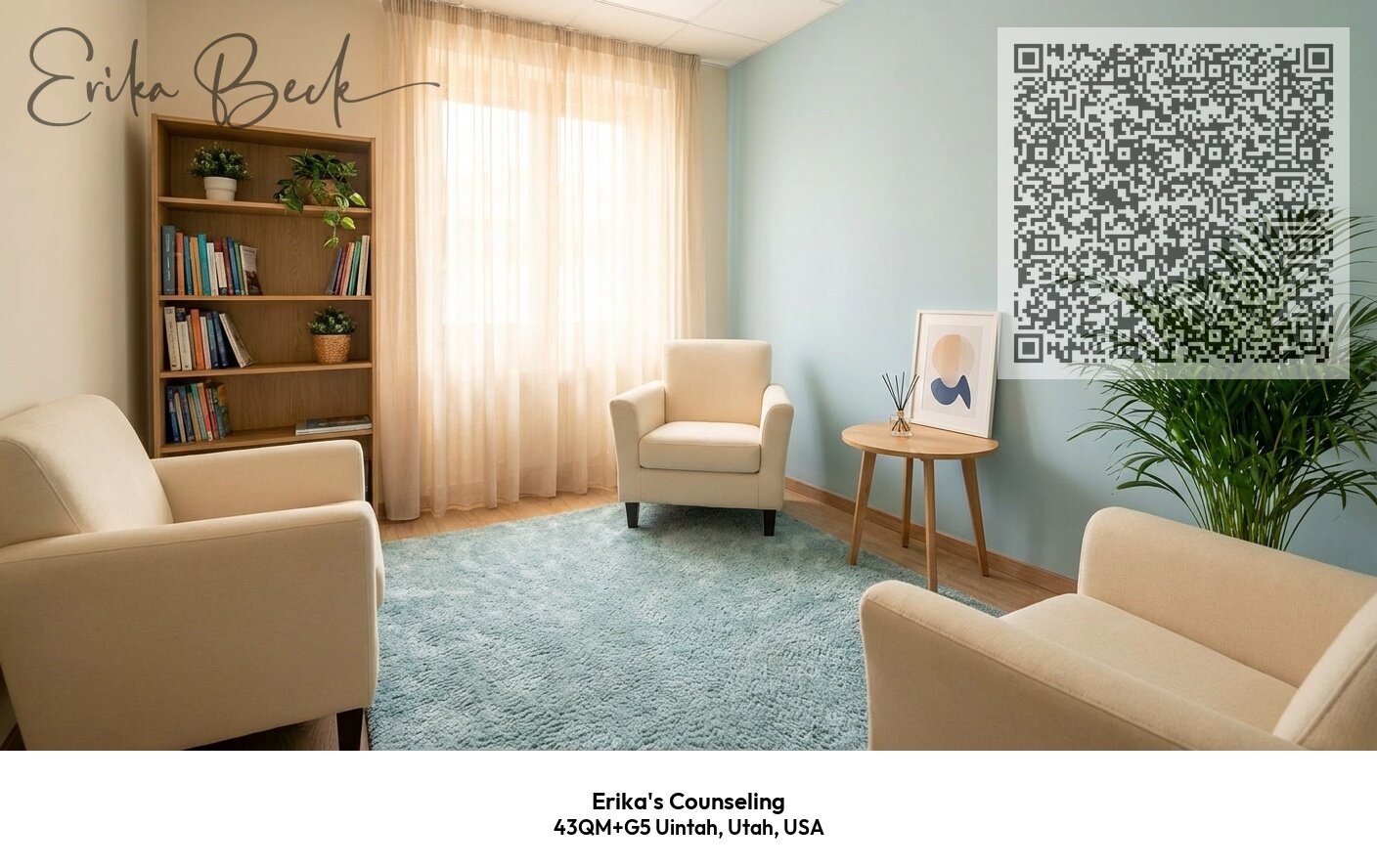
For local visitors, the matching public listing places Erika's Counseling at 6696 South 2500 East Ste 2A in Uintah, Utah.
The practice focuses on creating a supportive, nonjudgmental setting where women can build coping skills, regulate emotions, and work through hard seasons with practical guidance.
If you are looking for a Uintah-based counseling office while also needing therapy licensed for Utah or Idaho, the site and listing provide a clear local starting point.
To ask about a free 15-minute consult, call 208-593-6137 or visit https://www.erikascounseling.com/.
For map directions and current listing hours, see https://www.google.com/maps/place/Erika's+Counseling/@41.138781,-111.9171075,17z/data=!3m1!4b1!4m6!3m5!1s0x875307cd5b7b0049:0x18b6b07ca7fe6b35!8m2!3d41.138781!4d-111.9171075!16s%2Fg%2F11mzyjzcs4.
Popular Questions About Erika's Counseling
What does Erika's Counseling offer?
Erika's Counseling offers counseling and coaching for women. The site highlights support for anxiety, depression, trauma, grief and loss, burnout, chronic stress, self-esteem, body image, boundaries, communication, and life transitions.Who leads the practice?
The website identifies Erika Beck, LCSW, as the therapist behind the practice.What therapy approaches are mentioned on the site?
The official site mentions Cognitive Behavioral Therapy (CBT), Exposure and Response Prevention (ERP), Acceptance and Commitment Therapy (ACT), Accelerated Resolution Therapy (ART), Internal Family Systems (IFS), Polyvagal Theory, mindfulness-based therapy, and compassion-focused therapy.Who is this practice designed to serve?
The site is written primarily for women, and it also mentions support for moms as well as anxiety coaching for teen and tween girls and their parents.Where can Erika's Counseling provide therapy?
The website says Erika Beck is licensed to provide therapy in Utah and Idaho.What does the site say about counseling versus coaching?
The counseling-versus-coaching page explains that therapy is for mental health treatment and can address past, present, and future concerns, while coaching is presented as forward-focused support for problem-solving, values, goals, and growth from a more stable starting point.Where is the Uintah office and what hours are listed?
The public listing shows Erika's Counseling at 6696 South 2500 East Ste 2A, Uintah, UT 84405. Listed hours are Tuesday through Thursday from 9:00 AM to 4:00 PM, with Sunday, Monday, Friday, and Saturday marked closed.How can I contact Erika's Counseling?
Call tel:+12085936137, email [email protected], visit https://www.erikascounseling.com/, or follow https://www.instagram.com/erikabeckcoaching/.Landmarks Near Uintah, UT
Uintah City Park — Uintah City describes this as a central community park with trees, sports courts, a playground, a baseball field, and picnic space. If you are near the park or city center, Erika's Counseling’s Uintah office is a practical local reference point for directions.Mouth of Weber Canyon — Uintah City says the community sits at the mouth of Weber Canyon. If you travel the canyon corridor regularly, the listed Uintah office provides a clear nearby therapy location reference.
Weber River — The city history page notes that Uintah is bordered by the Weber River on the south and west. If you use the river side of town as a local point of reference, the public map listing can help with routing to the office.
Uintah Bench — Uintah City notes the Uintah Bench to the north of town. If you are coming from bench-area neighborhoods and roads, the practice’s Uintah address gives you a simple local destination to work from.
Wasatch Mountains — The city history page places the Wasatch Mountains to the east of Uintah. If you live along the foothill side of the area, Erika's Counseling remains part of that same local Uintah setting.
Historic 25th Street — Visit Ogden describes Historic 25th Street as a major destination for shops, events, art strolls, and local activity. If you split time between Uintah and downtown Ogden, the Uintah office remains within the same broader local area.
Ogden Union Station — Ogden’s Union Station and museum district remains one of the area’s best-known landmarks. If you use Union Station or west downtown Ogden as a directional anchor, Erika's Counseling’s Uintah address is a useful nearby point of reference.
Hill Aerospace Museum — The official museum site presents Hill Aerospace Museum as a major visitor destination with free admission and extensive aircraft exhibits. If you commute through the Hill AFB corridor, the Uintah office is a helpful local therapy reference for route planning.
Ogden Nature Center — The Ogden Nature Center is a well-known education and wildlife destination in Ogden. If you are near west Ogden or use the nature center area as a landmark, Erika's Counseling’s Uintah location is still a recognizable nearby option.